

How Many Security Guards Does Your Event Need?
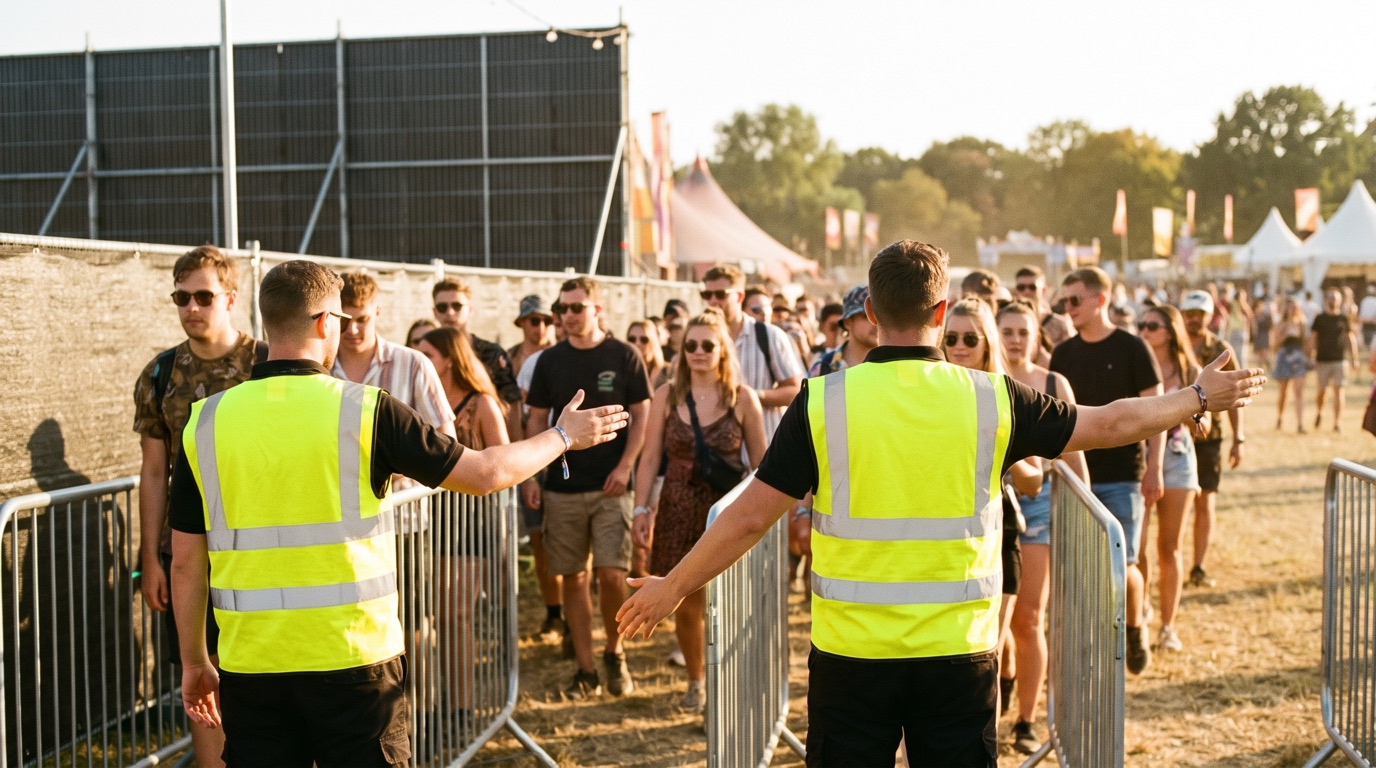
The short answer is one security guard for every 50 to 100 attendees, and where you land in that range is decided almost entirely by alcohol, crowd density, and the hour. That's the planning number every event security firm starts from, and it's the number a venue or an insurer will expect you to have used when they ask. A quiet, seated, daytime event with no bar sits near the 1-per-100 end. A packed, standing, late-night event with alcohol flowing moves to 1 per 50, and a concert or a large open-footprint event tightens further toward 1 per 25 to 50.
But the ratio is where sizing starts, not where it ends. It's a baseline for a risk assessment, not a code you can plug your capacity into and walk away. Two events with 800 people can need wildly different staffing: 800 seated for a comedy taping is a different animal from 800 standing at a warehouse party with a bar until 2am. The right way to think about it is that the ratio sets your floor, and every risk factor on top of it, alcohol, layout, cash on site, VIP presence, ticket demand, ratchets you up from there.
This guide covers how to turn that ratio into an actual guard count for your event type, what those guards cost in 2026, the difference between licensed guards, off-duty police, and unlicensed staff, and the part organizers skip until it bites them: when the venue or your insurance policy makes the decision for you no matter what your own math says.
What is the security ratio for events?
The event security ratio is one guard per 50 to 100 attendees, and you tighten it based on risk. That single rule covers most of what you need, but the useful version breaks it down by the factors that actually move the number. Alcohol is the biggest one. The moment you have a bar, planning guidance drops toward one guard per 50, and firms that specialize in nightlife often plan tighter than that. Standing-room crowds need more coverage than seated ones because people move, bunch, and press toward stages and bars. Late hours raise the number because fatigue and intoxication compound as the night runs. And a large outdoor footprint needs more bodies simply because there's more perimeter and more distance between any two staff.
Here's how the baseline shakes out across the event types most independent organizers actually run:
| Event type | Planning ratio | Why |
|---|---|---|
| Seated daytime (comedy matinee, conference, expo) | 1 per 100 | Low movement, no alcohol, controlled entry |
| Food festival / family daytime | 1 per 75 to 100 | Open footprint offsets the calm crowd |
| Standing show / mid-size concert | 1 per 50 to 75 | Movement toward the stage, some alcohol |
| Club night / party with a bar | 1 per 40 to 50 | Alcohol, late hours, dense standing crowd |
| Large festival / high-demand concert | 1 per 25 to 50 | Perimeter, stages, alcohol, crowd surges |
Read those as starting points for a peak-attendance count, not an average. Size to the busiest moment the room will hold, because that's when incidents happen and that's the headcount a fire marshal or an insurer cares about. If your event runs a sharp arrival surge, the same crunch a basketball tournament gate hits in the ninety minutes before the first games, weight your staffing toward doors and entry for that window, then let some of them float to the floor once the rush clears.
Turn the ratio into a real number
Multiply your peak headcount by the ratio, then add fixed-post staff the ratio doesn't cover. The ratio gives you general coverage: the guards watching the crowd, the floor, and the perimeter. It does not include the people locked to a specific job. A door needs dedicated entry staff regardless of how big the crowd inside gets. A VIP area, a backstage, a cash room, or a restricted lot each needs its own body. Those are fixed posts you add on top of the ratio number, not out of it.
So the working formula is two parts: ratio coverage (peak attendance divided by your risk-adjusted ratio) plus fixed posts (one per door lane, plus one each for VIP, backstage, cash handling, and any restricted zone). A 600-cap standing show with a bar might pencil out to roughly 10 to 12 general guards at a 1-per-50 ratio, plus two on the main door, one on the green room, and one supervisor coordinating, landing you around 15 staff. The same 600 people seated for a daytime comedy show with no bar might need 6 general guards plus a door and a supervisor, closer to 8.
One more layer worth naming: not every body at your entrance needs to be a licensed guard. Scanning tickets and directing traffic is a job for trained event staff; watching for and de-escalating trouble is a job for security. Splitting those roles keeps your guard count, and your bill, right-sized. It also keeps your systems clean. Give scanners their own scanner PINs on their own phones so several entry lanes run at once, each scan is attributed to a person, and your door workers never touch the parts of your dashboard they don't need. Guards guard; staff scan; the roles don't blur.
Alcohol changes both the ratio and your liability. Once you're serving, most states expose you to dram-shop and general-liability claims if an over-served guest hurts someone, and your insurer will often require licensed, insured security as a condition of coverage. This is not the place to save money with a friend in a black t-shirt. Confirm what your liquor liability policy and your venue require in writing before you set the guard count, because an uninsured guard at an alcohol event can void the coverage you're paying for.
Licensed guards, off-duty police, or event staff?
Match the tier of protection to the tier of risk, and don't over-buy. Most events are served by licensed, insured unarmed guards, and that's the right default. They're trained, they carry the liability coverage that matters, and they handle the actual job of a normal event: watching entrances, managing lines, spotting trouble early, and de-escalating it. For the majority of comedy shows, festivals, conferences, and club nights, a team of licensed unarmed guards plus your own event staff is the complete answer.
You step up from there for specific reasons, not by default. Armed guards make sense when there's significant cash on site, high-value goods, or a credible threat, and they cost more because of licensing, training, and liability. Off-duty police are the top tier: they bring arrest authority, de-escalation training, and a uniform that changes crowd behavior on sight, which is why high-profile events and anything with a real security concern use them. Many municipalities also require off-duty officers for street closures, large capacities, or events on public property, so sometimes it's not a choice.
At the other end, unlicensed staff have a place, but a narrow one. Greeters, ushers, wristband-checkers, and line managers don't need a guard license, and using trained event staff for those roles is smart budgeting. What unlicensed staff should never do is the security job itself: breaking up fights, ejecting patrons, or handling intoxicated guests. That's where organizers get sued, and it's exactly the line an insurer draws. If a task involves putting hands on a guest or making a safety call, it belongs to a licensed guard.
How much does event security cost?
In 2026, budget roughly $25 to $40 an hour for an unarmed guard nationally, more in expensive metros, with armed guards and police running higher. Here's where the market actually sits, pulled from current event security pricing guides:
| Staff type | 2026 hourly rate | Notes |
|---|---|---|
| Unarmed guard (national) | $25 to $40 | The default for most events |
| Unarmed guard (LA / NYC / SF) | $30 to $60 | High-cost metro premium |
| Armed guard | $40 to $75 | Cash, valuables, or elevated threat |
| Off-duty police | $60 to $100+ | Public property, large capacity, high profile |
| Supervisor / lead | Add 15 to 25% | For teams of roughly 6 or more |
Two details turn that hourly number into a real budget. First, almost every firm bills a minimum shift, usually four hours per guard, so a three-hour event still gets billed for four. Second, your hours run longer than your event: guards arrive before doors for a briefing and stay past close for load-out and lot clearing, so a 4-hour show is often a 6-hour security bill. The formula that holds up is guards times hourly rate times actual hours on site, plus the supervisor premium, plus any equipment or metal-detector rental.
Put concrete numbers on it. That 600-cap standing show with a bar, at 15 staff for a 6-hour call at $35 an hour, runs about $3,150 for the night. The seated daytime version at 8 staff for a 5-hour call lands near $1,400. Security is rarely your biggest line, but it's a fixed cost that hits before a single ticket is scanned, which is exactly why it belongs in your break-even math from the start. If you're still working out whether the event clears at all, our breakdown of what actually makes events profitable shows where a fixed cost like this sits against the margins for your event type, and a full-scale music festival budget treats security as one of the anchor line items it has to fund months before revenue arrives.
Your live entry count is a compliance tool, not just a sales number. Because QR check-in gives you a running scanned-in headcount against tickets sold, you can show a fire marshal or a venue manager exactly how many people are inside at any moment, and you can stop entry the instant you approach the room's rated occupancy. That single number, visible on a phone at the door, is the difference between a defensible "we were at capacity and held the line" and a guess. Pair it with a hard occupancy cap and your security team is enforcing a number, not a vibe.
Do I need security for a 200-person event?
Almost always yes, and usually at least two to four staff. Organizers running smaller events talk themselves out of security because 200 people feels manageable, and for a seated, daytime, alcohol-free event, two or three trained door-and-floor staff genuinely might cover it. The trouble is that "200 people" hides everything that matters. Two hundred people standing at a night event with an open bar is a different risk than 200 seated for an afternoon panel, and the staffing follows the risk, not the raw count.
Three things override your own judgment at any size. The venue often requires a minimum security presence in its rental agreement, sometimes its own staff at your expense. Your insurance or liquor liability policy may make licensed security a condition of coverage the moment you serve alcohol. And local permits for public-space events, amplified sound, or larger capacities can mandate a specific security or police presence. Any one of those turns "do I need security" from your call into a requirement, so the first move for a small event isn't to estimate a guard count, it's to ask the venue and read your policy.
Where you land, don't run the door on trust. A small event is where a single unwatched entrance leaks free entries all night, so give whoever works your door a scanner on their phone and a clean count, the same door discipline that keeps a ticketed watch party from bleeding cash at the entrance. Two hundred people is small enough that one determined line-jumper is a real percentage of your gate.
Frequently Asked Questions
What is the security ratio for events?
The planning standard is one security guard for every 50 to 100 attendees. A calm, seated, daytime event with no alcohol sits near the 1-per-100 end. Add a bar, standing room, late hours, or a large open footprint and the ratio tightens to 1 per 50, and higher-risk events like concerts push toward 1 per 25 to 50. It's a planning baseline for a risk assessment, not a legal formula, so adjust it up for your specific crowd.
How much does event security cost?
In 2026, unarmed event guards run about $25 to $40 an hour nationally and $30 to $60 in high-cost metros. Armed guards run $40 to $75 an hour, and off-duty police officers run $60 to $100 or more. Most companies bill a minimum shift of four hours per guard, so budget by (guards x hourly rate x hours) plus any setup and supervisor premium, not by a flat per-event number.
Do I need security for a 200-person event?
Usually yes, at least two to four staff. A 200-person seated daytime event with no alcohol might get by with a couple of trained door and floor staff. Add alcohol, standing room, or a late crowd and you want three or four guards, plus your venue or your liquor liability policy may require licensed security regardless of headcount. Confirm the requirement with the venue before you decide it's optional.
Start at one guard per 50 to 100 attendees, size to your peak headcount, and ratchet up for alcohol, standing room, late hours, and open footprint. Add fixed-post staff for doors, VIP, backstage, and cash on top of the ratio number, and split the jobs: licensed guards handle security, trained event staff scan and direct. Budget $25 to $40 an hour for unarmed guards in 2026 (more in big metros, more for armed or police), remember the four-hour minimums and the pre- and post-event hours, and put the total in your break-even math because it's fixed cost. Most important, before you finalize any of it, confirm what your venue, your permit, and your liquor liability policy actually require, because for a lot of events the number isn't yours to choose.
Related Posts
How to Stop Scalpers at Your Event
You can't make an event scalper-proof, but you can make your tickets a bad target. Here's what actually works, from a company that grew up in resale.
Door Sales Done Right: The Box Office Guide for Independent Events
For club nights and comedy shows, a large share of tickets still sell at the door, and that's the leakiest cash in your whole operation. Here's how to price it, take cards, and keep the count honest.
Event Permits and Insurance: What US Organizers Need
A permit costs less than you fear and takes longer than you think. Here's which events trigger one, what the paperwork actually runs, and the insurance a venue will make you carry.